
Introduction
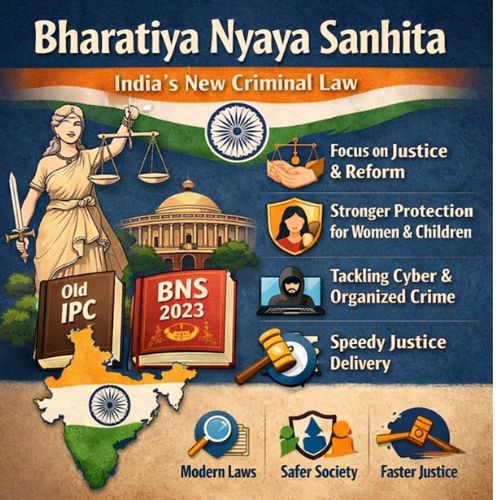
India’s criminal justice system has undergone a historic transformation with the introduction of the Bharatiya Nyaya Sanhita (BNS). Replacing the colonial-era Indian Penal Code (IPC), this new legislation aims to modernize criminal law, align it with contemporary societal needs, and ensure faster justice delivery.
Why Was a New Law Needed?
The IPC was enacted in 1860 during British rule. While it served as the backbone of criminal law for over 160 years, it reflected colonial priorities rather than the realities of modern India. Issues like cybercrime, organized crime, mob lynching, and crimes against women required updated legal definitions and stronger provisions.The Bharatiya Nyaya Sanhita was introduced to:
- Remove outdated colonial concepts
- Address modern forms of crime
- Focus on justice rather than punishment alone
- Simplify legal language for better understanding
Key Objectives of Bharatiya Nyaya Sanhita
One of the central goals of the BNS is to ensure speedy justice. Delays in criminal trials have long been a concern in India, and the new law attempts to streamline procedures and reduce backlog.Another important objective is victim-centric justice. Unlike earlier laws that focused heavily on the offender, the BNS gives greater importance to victims’ rights, compensation, and rehabilitation.
The law also emphasizes national security and integrity, introducing stricter provisions against terrorism, organized crime, and activities that threaten the sovereignty of India.
Major Changes Introduced in BNS
The Bharatiya Nyaya Sanhita brings several noteworthy changes compared to the IPC. One of the most discussed additions is the explicit inclusion of “terrorism” as a defined offence. Earlier, such provisions were covered under special laws, but now they are integrated into the main criminal code.Another significant change is the introduction of stricter punishments for crimes against women and children. Offences like gang rape, sexual harassment, and trafficking have been redefined with more stringent penalties.
The BNS also addresses mob lynching, which was not specifically covered under the IPC. This reflects the government’s intent to tackle emerging forms of collective violence.Additionally, community service has been introduced as a form of punishment for minor offences. This marks a shift towards reformative justice rather than purely punitive measures.
Focus on Technology and Modern Crimes
With the rapid growth of digital technology, crimes have evolved beyond traditional boundaries. The Bharatiya Nyaya Sanhita incorporates provisions to deal with cyber offences, online fraud, and digital harassment.
By recognizing electronic evidence and digital crimes more explicitly, the law ensures that the justice system keeps pace with technological advancements. This is particularly important in today’s interconnected world where crimes can be committed across borders with ease.
Impact on Law Enforcement and Judiciary
The implementation of the BNS is expected to bring significant changes to policing and judicial processes. Law enforcement agencies will need to adapt to new definitions of crimes and updated procedures.Training and awareness will play a crucial role in ensuring smooth implementation. Judges, lawyers, and police officers must understand the nuances of the new law to apply it effectively.
At the same time, the emphasis on timelines and efficiency may help reduce delays in trials, thereby improving public trust in the justice system.
Criticisms and Concerns
While the Bharatiya Nyaya Sanhita has been widely welcomed as a progressive reform, it has also faced criticism. Some experts argue that certain provisions may be open to misuse or lack sufficient clarity.
There are also concerns about the readiness of the system to implement such a major overhaul. Transitioning from the IPC to a completely new framework requires extensive training, infrastructure upgrades, and public awareness.Moreover, debates continue around balancing stricter laws with the protection of individual rights and freedoms.
Conclusion
The Bharatiya Nyaya Sanhita represents a landmark shift in India’s legal landscape. By replacing the outdated IPC, it aims to create a more responsive, efficient, and just criminal law system.
While challenges in implementation remain, the new law has the potential to redefine how justice is delivered in India. Its success will ultimately depend on how effectively it is enforced and how well it adapts to the evolving needs of society.As India moves forward with this transformation, the Bharatiya Nyaya Sanhita stands as a symbol of legal reform rooted in modern values and national priorities.