
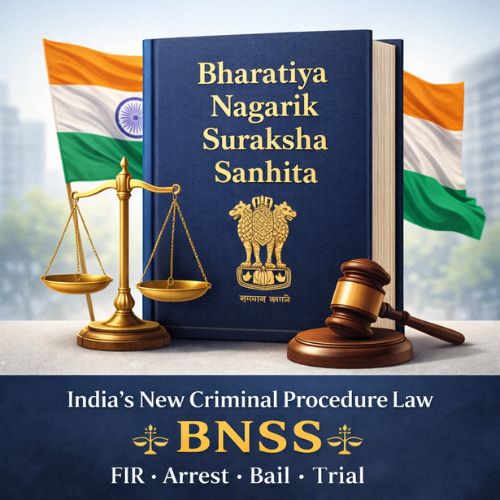
 FIR Registration
FIR Registration
At Balaw Associates, we highlight that when a person reports a cognizable offence, the police are legally required to register a First Information Report (FIR) under the Bharatiya Nagarik Suraksha Sanhita (BNSS). This is the first and most crucial step in the criminal justice process, as it formally records the complaint and sets the legal system in motion.
⚖️ Procedure:
- The police must record the FIR based on the information given by the complainant
- A copy of the FIR should be provided to the complainant free of cost
- Police can begin investigation immediately without prior court approval
- The process ensures transparency, accountability, and proper record keeping
 Arrest Procedure
Arrest Procedure
BNSS lays down clear rules on how a person can be arrested by the police. It ensures that arrests are made lawfully and protects individuals from misuse of authority. The procedure balances the need for law enforcement with the protection of personal liberty. Protects individual rights during arrest.
⚖️ Punishment:
- The police must inform the person about the reason for arrest
- The arrested person has the right to consult a lawyer
- The accused must be produced before a magistrate within 24 hours
- Illegal detention or unnecessary delay in production is not allowed
 Bail Procedure
Bail Procedure (BNSS Concept)
BNSS provides guidelines for granting bail based on the type of offense. It ensures that individuals are not unnecessarily detained and are given a fair opportunity to defend themselves while also considering the seriousness of the crime. Ensures balance between liberty and justice.
⚖️ Punishment:
- Bail is granted as a matter of right in bailable offenses
- In non-bailable offenses, the court decides based on facts and circumstances
- The court may impose conditions such as sureties or restrictions
- The process ensures the accused can participate in a fair trial
 Investigation
Investigation Procedure
BNSS defines how police should conduct investigations in a lawful and systematic manner. It includes collecting evidence, examining witnesses, and maintaining proper records to support the case in court. Ensures fair and lawful investigation process.
⚖️ Punishment:
- Police collect evidence and record witness statements
- Search and seizure must be conducted as per legal rules
- A case diary is maintained with all investigation details
- A report is submitted to the magistrate after completing investigation
 Charge Sheet Filing
 Charge Sheet Filing
After completing the investigation, the police must file a charge sheet before the court. This document contains all evidence, findings, and details about the accused, helping the court decide whether to proceed with the trial. Helps court decide whether trial should begin.
⚖️ Punishment:
- Charge sheet must be filed within the prescribed time limit
- It includes details of evidence, witnesses, and offenses
- The report is submitted to the magistrate or appropriate court
- The accused is provided a copy to prepare their defense
 Trial Procedure
Trial Procedure
BNSS outlines the steps involved in conducting a trial in court. It ensures that both prosecution and defense get equal opportunity to present their case and that justice is delivered fairly. Ensures fair and transparent justice delivery.
⚖️ Punishment:
- The court frames charges against the accused
- Witnesses are examined and evidence is presented
- Both sides present their arguments before the court
- The judge delivers the final judgment based on facts and law
